Italian Life
Italy's cultural life cannot easily be reduced to a single set of traditions, customs, or everyday habits. Language, festivals, cuisine, crafts, and forms of community life vary from region to region and are often associated with a particular city or community.
The best way to discover Italy is therefore through its geography and cultural context: where a tradition originated, who preserves it, how it has developed, and what role it plays in contemporary life. This approach reveals the country as a collection of diverse regional cultures rather than a set of stereotypes.
Regions and cities
of Italy
Italy's cultural landscape is shaped by regional and local traditions. This diversity is also reflected in how government cultural institutions describe the country's heritage: cultural sites, crafts, and practices are examined in relation to their geographical location, historical period, and broader historical context.
For example, Opera dei Pupi — Sicilian puppet theatre — is primarily associated with Sicily. Within this tradition, the Palermo and Catania schools differ in the size and construction of their puppets, manipulation techniques, and performance styles.
Traditional violin craftsmanship in Cremona is associated with the city of the same name in Lombardy. Professional knowledge is passed down through training, workshop practice, and direct interaction between masters and apprentices.
Canto a tenore — traditional Sardinian polyphonic singing, also known as pastoral singing — originated in Sardinia and is particularly associated with the central part of the island. The tradition preserves local performance variations and maintains close ties with the cultural environment of individual communities.
These examples demonstrate why cultural practices should be associated with their geographical origins and the communities that preserve them rather than automatically regarded as traditions shared throughout Italy.
Annual calendar
In Italy, it is important to distinguish between several types of dates: official public holidays, civic commemorations, religious holidays, regional and municipal events, and activities organized by individual organizations. Their legal and cultural status varies: a commemorative day is not necessarily a non-working public holiday, and a religious celebration does not automatically have official civic status.
Key national dates include:
| Date | Name | Status and Significance |
|---|---|---|
| March 17 | Giornata dell'Unità nazionale, della Costituzione, dell'inno e della bandiera — National Unity, Constitution, Anthem and Flag Day | Official nationwide commemorative day. Not a non-working public holiday |
| April 25 | Anniversario della Liberazione — Liberation Day | Official public holiday commemorating Italy's liberation from Nazi-Fascism |
| May 1 | Festa del Lavoro — Labour Day | Nationwide public holiday |
| June 2 | Festa della Repubblica — Republic Day | National public holiday |
| October 4 | Festa nazionale di San Francesco d'Assisi — National Feast of Saint Francis of Assisi | National public holiday |
| November 4 | Giornata dell'Unità nazionale e delle Forze armate — National Unity and Armed Forces Day | Official nationwide observance, but not a non-working public holiday |
Festivals and Living
Traditions
A living tradition is more than a story about the past. It continues to exist through the people and communities who practice it and pass it on to future generations. This is the principle UNESCO applies when working with intangible cultural heritage.
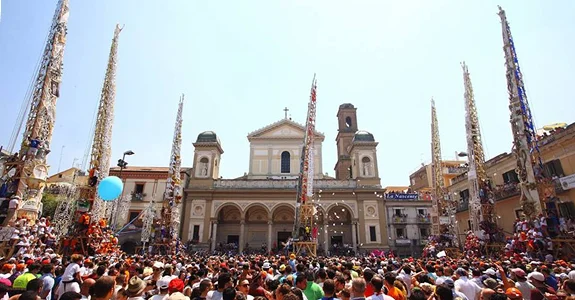
Festa dei Gigli
Festival of the LiliesThe festival is associated with the veneration of Saint Paulinus of Nola. Its central features are tall wooden structures known as lilies, whose construction and transportation require the participation of craftspeople, bearers, musicians, and other members of the local community.
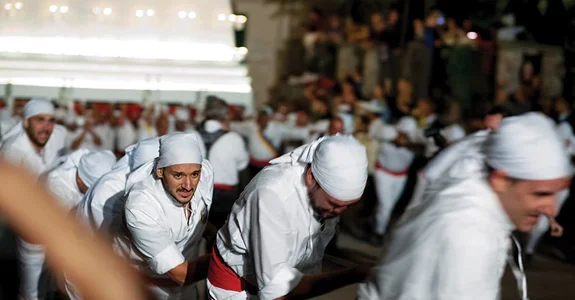
Macchina di Santa Rosa
Tower of Saint RoseThis urban tradition is dedicated to Saint Rose, the patron saint of Viterbo. During the main event, a 30-meter-high sculptural tower is carried through the city's historic center. This is a local tradition specific to Viterbo rather than a practice shared throughout Italy.
Language, Dialects, and Everyday Etiquette
Italian is the official language of the Italian Republic, but the country's linguistic landscape is considerably more diverse. Legislation provides specific protections for historical linguistic minorities, including speakers of Sardinian, Friulian, Ladin, Slovenian, French, and several other languages.
Therefore, lingua italiana — the Italian language, dialetto — dialect, and lingua minoritaria — minority language — should not be used interchangeably.
Language use also depends on the social context. A dialect or regional form of speech may be common among family members and friends but used much less frequently when speaking with strangers or in formal settings.
In formal or moderately formal situations, Lei is generally used to address one person politely, corresponding to the formal "you." For example, at a municipal office, you might say:
- Lei può aiutarmi con questa pratica?— "Can you help me with this procedure?"
- Lei ha bisogno di altri documenti?— "Do you need any other documents?"
In everyday speech, the pronoun Lei is often omitted because the verb form and related pronouns (Le, La, Suo) already indicate formal address.
In conversations between acquaintances, tu — the informal form of "you" — is more commonly used. It is typical when speaking with friends, relatives, close colleagues, and people with whom an informal relationship has already been established.
For example:
- Come stai?— "How are you?"
- Puoi aiutarmi con questa cosa? — "Can you help me with this?"
- Ci vediamo domani sera.— "See you tomorrow evening."
Unlike Lei, tu is used with the second-person singular verb form:
- Lei può aiutarmi? → "Can you help me?" (formal)
- Tu puoi aiutarmi? → "Can you help me?" (informal)
Cuisine, Crafts, Music,
and Theatre
Cuisine, crafts, music, and theatre reveal Italian culture through specific places and communities. What matters is not only the finished product or artistic work but also the knowledge, working methods, and ways in which traditions are transmitted.
The Art of Neapolitan Pizzaiuolo involves much more than simply making pizza.The tradition includes professional dough-handling techniques, the characteristic movements used by skilled pizzaiuoli to shape the dough, the use of a wood-fired oven, and interaction with customers.
Knowledge is passed down primarily through practical experience: young pizzaiuoli learn directly from experienced masters in a bottega — workshop. The cultural heritage therefore lies in the professional practice and the environment in which it is transmitted, rather than in a particular recipe.
Cremonese craftspeople make violins by hand from numerous individual wooden components. Particular importance is attached to the selection of wood, shaping of the instrument's body, its acoustic properties, and the individual craftsmanship involved.
The tradition is fundamentally rooted in manual work and the transmission of knowledge from master to apprentice. Each instrument is individually crafted, which is why Cremona's violin-making heritage is regarded not as mass production but as a distinctive professional tradition of the city.
Canto a tenore is performed by four male voices — bassu, contra, boche, and mesu boche. The singers usually stand in a close circle, creating a distinctive sound through the combination of different vocal parts.
The tradition is primarily associated with the pastoral culture of central Sardinia and may accompany family, religious, and community events.
The Practice of Opera Singing in Italy combines vocal technique, stage performance, acting, and the transmission of knowledge from teacher to student.
This tradition exists not only on the stages of major opera houses but also in conservatories, academies, singing schools, and the professional community of performers.
Sicilian puppet theatre combines performing arts and craftsmanship. Craftspeople create and decorate puppets, manipulate them during performances, and pass on technical and theatrical knowledge within the professional community. The tradition developed in the 19th century and is associated with performances based on chivalric literature.
This approach reveals not only the finished results behind familiar cultural symbols but also the people, techniques, and communities that enable these traditions to continue.
Art and Cultural Heritage
Italy's cultural heritage extends far beyond its most famous museums and monuments.
The Catalogo Generale dei Beni Culturali — General Catalogue of Cultural Heritage — contains information about archaeological, architectural, artistic, photographic, ethno-anthropological, musical, scientific, and other cultural objects. These are examined alongside information about their creators, historical periods, geographical locations, and historical contexts.
UNESCO World Heritage represents another level of cultural heritage recognition. Italy has sites of various types, including historic city centers, archaeological areas, architectural monuments, cultural landscapes, and natural sites.
For example, in 2025, Funerary Tradition in the Prehistory of Sardinia – The domus de janas was inscribed on the World Heritage List. It brings together archaeological sites associated with the funerary practices of the island's prehistoric societies.
Italy's cultural heritage therefore encompasses different territories and historical periods, from prehistoric Sardinia to urban architectural ensembles and contemporary museum institutions.